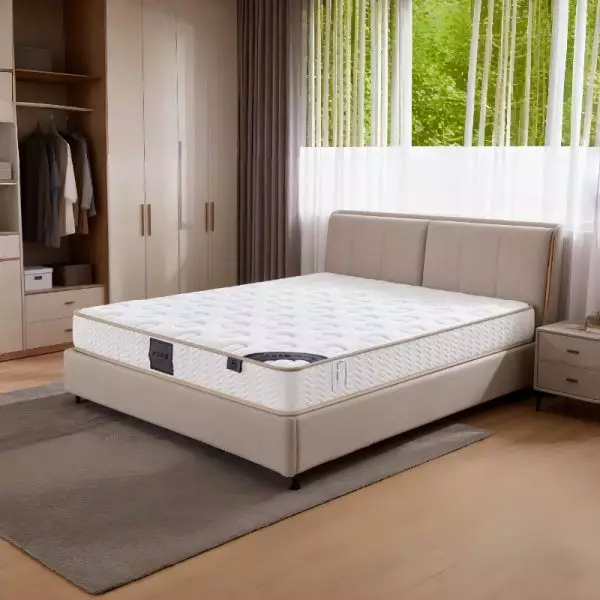
A pocket spring mattress can be designed with a uniform support system, but zoning allows manufacturers to make different areas respond differently to pressure. This approach is increasingly relevant for mattress brands and commercial buyers looking for more targeted support without abandoning the responsive characteristics of a spring construction.
For businesses evaluating products from spring mattress manufacturers, understanding how zoning works is important. The number of zones, coil specifications, transition areas, comfort layers, and perimeter construction can all influence the finished mattress. A well-designed zoned system should therefore be evaluated as a complete structure rather than as a simple coil-count feature.
What Is a Zoned Pocket Spring Mattress?
Pocket springs are individually wrapped coils that respond more independently to pressure. A zoned pocket spring mattress uses different support characteristics across sections, such as firmer support under the torso and hips and more adaptable support around the shoulders and legs. The goal is to distribute body weight more effectively and create a balanced support profile.
How Are Support Zones Created?
Manufacturers can create different zones by adjusting coil gauge, dimensions, height, spacing, count, and geometry. Lower-gauge wire is thicker and generally provides firmer resistance, while higher-gauge wire is thinner and more flexible. Zone transitions should also be gradual to avoid noticeable changes in surface feel, especially when adapting the design to different mattress sizes.
Benefits of Zoned Pocket Springs
Pocket coils can provide localized support and better motion isolation than interconnected spring systems. Zoning adds further control by creating different responses for the shoulders, torso, hips, and legs. However, the number of zones alone does not determine performance. The overall support profile and transition between zones are equally important.
Consider Perimeter Support
Edge construction should be evaluated separately from the internal zones. Lower-gauge coils, narrower coils, or high-density foam can be used to strengthen the perimeter and reduce excessive edge compression. Strong edge support can improve stability and make more of the mattress surface usable.
Comfort Layers Affect the Final Feel
The spring system is only part of the mattress. Foam, latex, fiber, quilting, and fabric can all change how the underlying zones feel. A firm zoned spring unit may feel softer with thicker cushioning, while thinner comfort layers can make the differences between zones more noticeable. Buyers should therefore evaluate the complete mattress rather than the spring specifications alone.
What Should Buyers Consider Before Ordering?
Businesses comparing a spring mattress manufacturer in China should request detailed information about the zoning structure. Useful specifications include the number of zones, coil type, coil count, wire gauge, spring height, perimeter reinforcement, and the materials used above the support core.
It is also important to clarify how zoning changes across different mattress sizes. Buyers should not assume that the same coil layout can simply be enlarged or reduced without modification.
Sample testing is another important step. A physical sample allows buyers to assess firmness transitions, edge stability, surface comfort, motion response, and overall construction before approving a larger production order.
How We Approach Spring Mattress Development at Suisin Furniture
At Suisin Furniture, we position spring mattresses within a broader product portfolio that serves different bedroom and commercial furnishing requirements. Our mattress range includes spring mattress products alongside handmade, compressed, and traditional mattress categories.
Our approach also considers the needs of business customers that require more than a standard retail product. The company provides OEM and ODM capabilities and operates a 200,000-square-meter production workshop, supporting customized furniture projects for international markets.
For buyers exploring our spring mattress solutions, the support structure can be considered alongside mattress dimensions, comfort materials, finishing, and intended market positioning. This provides a more practical basis for developing a product specification.
Why Market Position Matters
Not every customer needs the same zoning strategy. A mattress intended for a broad hospitality market may require a balanced support profile that accommodates different users. A specialized retail model may instead emphasize targeted support as a key selling point.
Price positioning also matters. More complex spring constructions can involve additional components and production requirements. Buyers should therefore determine whether the expected performance benefits justify the added construction complexity.
For private-label businesses, zoning can become part of a product’s identity when it is supported by a clear comfort concept and appropriate specifications.
Choosing a Zoned Pocket Spring Design
A zoned pocket spring mattress combines independent coil movement with targeted support across different sections of the sleeping surface. Its effectiveness depends on how coil specifications, zone placement, transitions, perimeter reinforcement, and comfort layers work together.
For buyers, the best approach is to evaluate the complete construction instead of relying on claims about having more zones or more coils. Ask for detailed specifications, test a representative sample, and consider how the design fits the intended market.
Working with experienced spring mattress manufacturers can also make the development process more practical. When zoning is treated as an integrated engineering decision rather than a marketing label, buyers can create a mattress with a clearer support concept, more predictable performance, and stronger product differentiation.