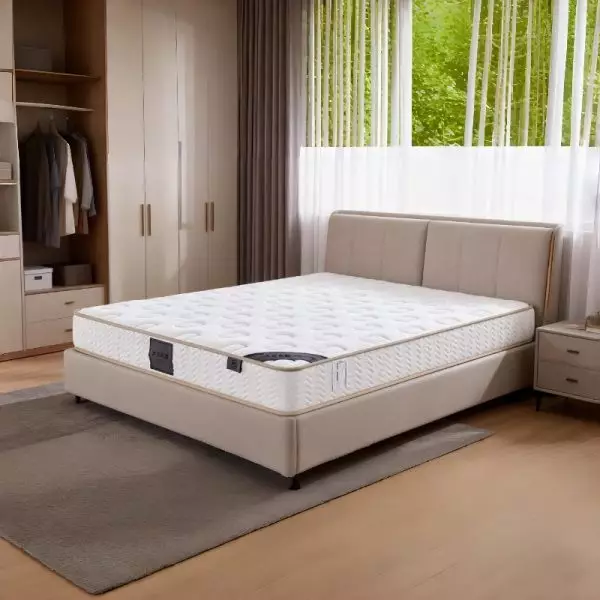
Roll-packing has become an important packaging method for mattresses sold through e-commerce, hospitality projects, export channels, and space-conscious logistics. By compressing a mattress and rolling it into a smaller package, manufacturers can reduce its shipping volume and simplify handling. However, not every mattress structure responds to compression and rolling in the same way. The internal construction must be considered before a roll-packing solution is selected.
What Makes a Mattress Suitable for Roll-Packing?
A roll-packed mattress needs a structure that can tolerate temporary compression while retaining its intended shape and performance after unpacking. Foam-based constructions are generally well suited because flexible foam layers can be compressed substantially and recover their original dimensions when released.
The construction also matters because a mattress is usually made from several functional layers. A comfort layer provides cushioning, a transition layer manages the change between comfort and support, and the support core stabilizes the mattress.
For roll-packing, manufacturers therefore need to evaluate the complete layer combination rather than simply looking at mattress thickness. Foam density, layer thickness, resilience, and cover construction can all affect compression and recovery.
Key Construction Factors for Roll-Packing
Roll-packing depends on more than whether a mattress contains foam or springs. Manufacturers should consider how the support core, comfort layers, cover, and other components respond to compression and recovery.
Mattress thickness, foam density, resilience, spring configuration, and layer arrangement can all influence packaging performance. Evaluating these factors together helps determine whether a mattress can be rolled efficiently while maintaining its intended comfort, support, and shape after unpacking. Packaging durability and storage conditions should also be considered to ensure the mattress remains protected throughout transportation and distribution.
All-Foam Mattresses: A Natural Fit for Compression
All-foam mattresses are well suited to roll-packing. Their flexible foam construction can be compressed into a compact package and recover after unpacking, making them practical for efficient storage, handling, and transportation.
However, material selection remains important. Foam density and firmness can affect compression and recovery, so manufacturers need to carefully balance packaging performance with comfort, support, and long-term durability requirements.
Pocket-Spring Hybrid Structures Can Also Be Rolled
Hybrid mattresses combine foam comfort layers with a spring-based support system. Pocketed coils are commonly used because their individually wrapped springs can move more independently.
Hybrid mattresses can also be compressed and rolled for boxed delivery, but the design must be suitable for this process. The spring system, foam layers, and cover all need to work together during compression, so buyers should confirm the packaging method with the manufacturer rather than assume every hybrid model can be rolled.
Why Traditional Innerspring Designs Require More Attention
Traditional innerspring mattresses may use interconnected systems such as Bonnell or continuous-wire coils, which differ from individually pocketed springs.
However, innerspring mattresses can also be compressed or rolled. The key is whether the specific spring unit, surrounding materials, and manufacturing process are designed for compression. A mattress intended for flat delivery may require additional engineering to perform reliably when rolled.
What Should Buyers Ask Rolled-Up Mattress Manufacturers?
When evaluating rolled-up mattress manufacturers, buyers should consider more than package size. Key factors include mattress construction, materials, compression performance, and whether the model is specifically designed for roll-packing.
Recovery after unpacking is equally important. Buyers should discuss compression levels, packaging duration, material characteristics, and handling conditions to ensure the mattress can consistently regain its intended form.
Customization also matters for B2B buyers, who may need different sizes, comfort levels, packaging, or private-label options. A capable manufacturer should address these requirements during product development rather than treating packaging as an afterthought.
How Suisin Furniture Approaches Compressed Mattress Solutions
We develop furniture and mattress solutions around practical customer needs. Our compressed mattress range provides a space-efficient option for packaging, storage, and distribution.
For us, the important point is that compression should be considered together with mattress construction, intended application, and logistics requirements. This approach can help B2B customers evaluate whether a particular structure is appropriate for their sales channel or project rather than selecting a packaging format in isolation.
When comparing rolled-up mattress factory suppliers, buyers can therefore consider both the mattress itself and the manufacturer’s ability to support different business requirements. Product construction, packaging, customization, and supply capability all contribute to a more suitable sourcing decision.
Choosing the Right Structure for Roll-Packing
In general, all-foam mattresses offer a straightforward foundation for roll-packing, while pocket-spring hybrids can also be engineered for compression and rolling. Traditional innerspring constructions require closer evaluation because their interconnected support systems may respond differently to compression.
The right mattress structure depends on comfort, support, packaging, transportation, and target market requirements. Buyers should evaluate the complete construction rather than choosing a model simply because it can be rolled.
At Suisin Furniture, we combine mattress manufacturing with compressed packaging solutions, helping businesses develop products that balance comfort, performance, and efficient delivery.