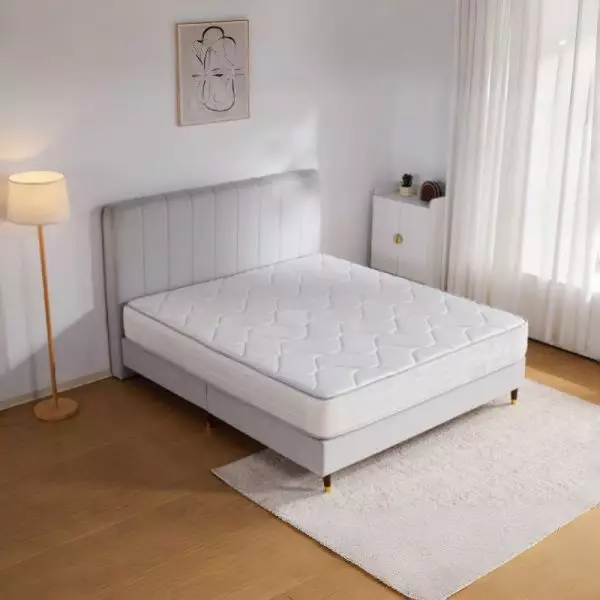
For e-commerce mattress brands, product quality is only one part of successful sourcing. Packaging, transportation, storage, handling, customization, and delivery all affect the customer experience and the retailer’s operating costs. Rolled-up mattresses can offer practical advantages because their compact packaging is designed around more efficient transportation and storage.
However, choosing among rolled-up mattress manufacturers requires more than comparing product photos and quotations. Online sellers should evaluate the manufacturing process, product construction, packaging, customization capabilities, and ability to support their specific sales model.
Why Rolled-Up Mattresses Suit E-Commerce
Traditional mattresses are bulky products that can occupy considerable warehouse and transportation space. A compressed mattress can be vacuum-packed and rolled into a more compact form, making it easier to package, transport, and store.
This format can be particularly useful for e-commerce businesses using direct-to-consumer fulfillment. Smaller packages are generally easier to move through warehouses and delivery networks, while retailers can potentially store more units within the same space.
What Should You Ask Rolled-Up Mattress Manufacturers?
Before choosing a supplier, buyers should understand exactly how the mattress will be compressed, packaged, and prepared for delivery. Ask whether the factory has dedicated vacuum compression and roll-packing equipment rather than relying on a general packaging process.
The packaging specification should also be clearly documented. It can include carton dimensions, materials, labeling requirements, and the expected condition of the mattress upon delivery.
A well-defined packaging specification helps an online retailer calculate warehouse requirements, shipping costs, and fulfillment procedures before placing a large order.
Check Mattress Construction and Recovery
Compression changes the physical size of a mattress for transportation, so buyers should understand how the product is designed to recover after unpacking. The mattress construction, materials, thickness, and compression method can all influence the finished product.
Ask the manufacturer how the mattress should be unpacked and how long it should be allowed to recover before use. These instructions can later be incorporated into product pages, packaging inserts, or customer service materials.
The buyer should also approve a production sample before bulk manufacturing. This provides an opportunity to check the mattress construction, dimensions, appearance, packaging, and unpacking experience together.
Evaluate Customization Capabilities
E-commerce brands often need products that match a particular market position rather than simply reselling an off-the-shelf mattress. Customization may involve firmness, thickness, foam layers, spring systems, fabric, dimensions, packaging, and branding.
Rolled-up mattress manufacturers should therefore be evaluated on both manufacturing capability and product development support. Buyers should ask whether the supplier can create OEM or ODM products and whether customized packaging and private-label requirements are supported.
Our compressed mattress solutions can be customized for different markets and price segments, including firmness, thickness, foam layers, spring systems, fabric, dimensions, and packaging methods.
Compare Rolled-Up Mattress Factories by Quality Control
A low factory price does not necessarily translate into a competitive e-commerce product. In online sales, returns and customer complaints can quickly increase the real cost of a poorly controlled product.
Ask rolled-up mattress factories how they inspect raw materials, monitor production, check finished products, and verify packaging. It is also useful to establish which product characteristics will be checked against the approved sample before shipment.
At Suisin Furniture, we operate standardized and automated production lines supported by multiple rounds of quality inspections. Suisin Furniture also has three production bases in China, supporting different mattress projects and production requirements.
Consider MOQ, Lead Time, and Scalability
At Suisin Furniture, we understand that e-commerce demand can change quickly, especially when brands are testing new products. We provide clear information on MOQ, samples, production lead times, and repeat-order capacity. Our sample lead time is approximately 10–15 days, while bulk production typically takes 30–35 days. Customized orders may require different timelines depending on their specifications and quantities.
Assess Shipping and Warehouse Efficiency
Our compressed mattresses are designed to take up less container and warehouse space than full-size mattresses, which can help buyers improve loading efficiency, storage, and handling. However, we recommend evaluating the actual landed cost based on each buyer’s shipping route, order volume, and fulfillment model.
Look for a Manufacturer That Supports Your Business Model
At Suisin Furniture, we support online retailers, private-label brands, mattress wholesalers, regional distributors, and furniture chains. Our compressed mattress solutions can also support customized specifications, packaging, and repeat production, helping businesses scale their product lines as demand grows.
Choose Based on the Complete Supply Chain
Selecting rolled-up mattress factories requires more than comparing prices. Buyers should consider product construction, compression and packaging, customization options, quality control, MOQ, lead time, and shipping efficiency. A lower quotation may not deliver better value once storage, freight, returns, and customer experience are taken into account.
For online mattress sellers, the ideal supplier should be able to maintain consistent product quality, provide efficient packaging, and meet the needs of the target market. Evaluating these factors together can help e-commerce businesses build a more reliable supply chain and ensure a smoother journey from production to final delivery.