A compressed mattress is designed to make transportation, storage, and delivery more efficient. By reducing its volume through compression and rolling, the mattress can be packed into a compact carton instead of being shipped at its full size. This approach is increasingly useful for importers, distributors, retailers, hotels, and e-commerce businesses. However, one practical question remains: how long can a compressed mattress stay rolled?
There is no single storage period that applies to every compressed mattress. The appropriate duration depends on its materials, construction, compression method, packaging, and storage environment. Understanding these factors can help B2B buyers manage inventory while protecting product quality.
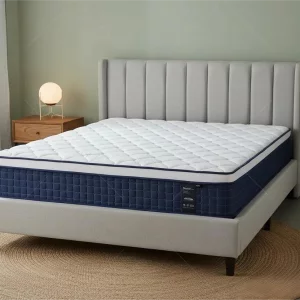
How Does a Compressed Mattress Stay Rolled?
A compressed mattress is placed inside protective packaging and compressed to reduce its overall volume. Depending on the construction, it can then be folded or rolled into a compact form before being placed in a carton. Industry research confirms that suitable foam, innerspring, and hybrid mattresses can be shipped in compressed and rolled formats, although the specific construction determines whether rolling is appropriate.
The main advantage is logistics efficiency. Compact packaging requires less container and warehouse space, allowing businesses to handle more units within available storage and transportation capacity. For international B2B supply chains, this can simplify handling and support more efficient distribution.
At Suisin Furniture, we use professional vacuum-packing equipment to compress and roll our mattresses into compact packages. Our compressed mattress range is designed for easier transportation, storage, handling, and delivery, making it suitable for brands, importers, distributors, retailers, hotels, and e-commerce businesses.
How Long Can a Mattress Stay Rolled?
The appropriate period depends on the specific mattress. Industry research indicates that compressed mattresses stored in their boxed state may have an approximate shelf life of six to twelve months, depending on the raw materials used. Extended compression, however, can affect performance, comfort, material integrity, shape recovery, resilience, and firmness.
This range should be treated as general industry information rather than a universal storage guarantee. Each mattress construction has different characteristics. Foam density, spring configuration, upholstery layers, fabric, compression level, and packaging can all influence how the mattress responds after remaining compressed.
For commercial inventory, buyers should therefore avoid assuming that every rolled mattress can be stored for the same length of time. The manufacturer’s recommended storage period should always take priority, particularly when a mattress has been customized for a specific market or application.
What Happens If a Mattress Stays Rolled Too Long?
The primary concern with extended compression is that the mattress may not recover its intended shape and characteristics as effectively after unpacking. Industry research notes that prolonged compression can contribute to material deterioration, loss of shape and resilience, and changes in firmness over time.
Recovery can also depend on environmental conditions. Temperature, humidity, and the condition of the packaging may influence the unpacking process. A mattress that has been stored for an extended period may require additional time to recover after the packaging is removed.
For this reason, warehouse teams should record incoming inventory dates and use an organized stock rotation system. Avoiding unnecessary long-term storage can reduce the risk associated with keeping compressed products packaged longer than necessary.
How Should Rolled Mattresses Be Stored?
Storage conditions matter just as much as storage duration. Compressed mattresses should remain protected from moisture, excessive heat, direct environmental exposure, and physical damage. Cartons should be handled carefully to avoid puncturing or damaging the protective packaging.
Warehouse operators should also avoid placing excessive weight on packaged mattresses. Keeping products in an organized, stable storage area makes it easier to monitor inventory and identify older stock that should be prioritized for shipment.
For B2B buyers, packaging labels can provide another useful management tool. Recording production dates, shipment dates, and recommended unpacking periods can help purchasing and warehouse teams establish a clear inventory rotation process.
Choosing Reliable Rolled–Up Mattress Manufacturers
When selecting rolled–up mattress manufacturers, buyers should evaluate more than the ability to compress and roll a mattress. Manufacturing capacity, quality control, product development, packaging capabilities, customization support, and communication are all important when building a long-term supply relationship.
We at Suisin Furniture provide compressed mattress solutions for global B2B customers. Founded in 2012 in Foshan, China, we integrate product design, R&D, manufacturing, sales, and service. Our company has a 200,000-square-meter production base, a 50-member R&D and design team, and more than 300 certified product patents.
Our compressed mattress category includes MT-203, MT-202, MT-206, MT-208, MT-209, and MT-210. The range includes different mattress constructions, while our manufacturing capabilities allow specifications such as firmness, thickness, foam layers, spring systems, fabric, dimensions, and packaging methods to be customized according to project requirements.
What to Ask a Rolled–Up Mattress Supplier
A reliable rolled–up mattress supplier should provide clear information about compression, packaging, storage, recovery, and product specifications. Buyers should ask how long a particular model can remain compressed and whether the recommended period changes according to its construction or packaging.
Customization is another important consideration for importers and private-label businesses. We support OEM and ODM projects, allowing customers to customize mattress sizes, materials, colors, styles, packaging, and branding according to their requirements.
Ultimately, the best approach is to treat a rolled mattress as a carefully engineered product rather than an item that can remain compressed indefinitely. Appropriate storage, stock rotation, suitable packaging, and manufacturer-specific guidance can help businesses maintain product quality throughout the supply chain.
As a professional compressed mattress manufacturer, we focus on balancing mattress development with practical transportation and storage requirements. By combining manufacturing, quality control, customization, and export support, we help global buyers develop compressed mattress collections suited to their target markets and supply-chain needs.