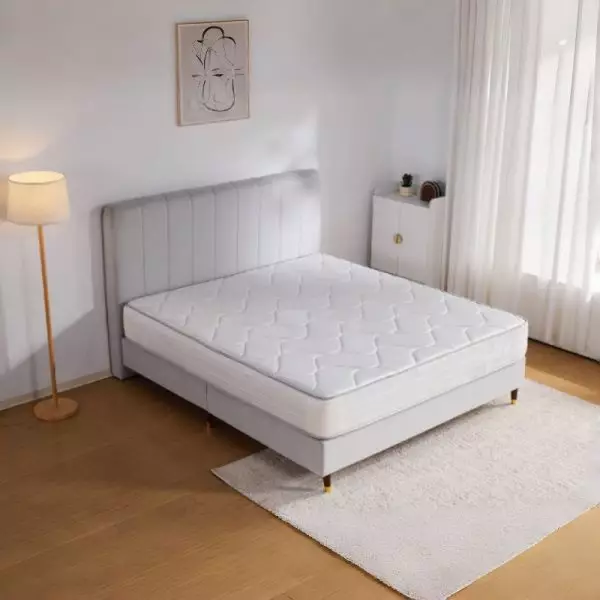
Compression is one of the defining features of a rolled mattress. By reducing the mattress volume before shipment, manufacturers can place the product into a much smaller package, making storage, transportation, and home delivery more manageable. However, compression is not simply a matter of making the mattress as small as possible.
The compression ratio needs to be balanced against material properties, recovery behavior, mattress construction, packaging dimensions, and customer expectations. For businesses sourcing from rolled-up mattress manufacturers, understanding this relationship can help them select products that provide both efficient logistics and reliable performance.
What Is Mattress Compression Ratio?
Compression ratio refers to how much a mattress’s volume is reduced during packaging. A mattress can be vacuum-compressed, rolled, and placed in a carton, making it much more compact for storage and transportation.
At Suisin Furniture, we use vacuum compression and roll-packing to create space-efficient mattress packaging. The appropriate compression level depends on the mattress materials and construction, so it should be determined through product testing rather than treated as a fixed standard.
Why Higher Compression Is Not Always Better
It may seem logical that greater compression is always preferable because a smaller package requires less space. In practice, excessive compression can create challenges if the materials are not suitable for the process.
Foam characteristics are particularly important. Foam density can influence durability, firmness, pressure response, and recovery behavior. Higher-density foams generally withstand pressure better, although their recovery characteristics can differ according to material type and formulation.
Manufacturers therefore need to establish a compression level that the specific mattress construction can tolerate without compromising its intended performance.
How Compression Affects Mattress Recovery
After the package is opened, the mattress begins to regain its original shape. The speed and completeness of this recovery depend on the materials and the amount of deformation created during packaging.
Foam-based mattresses are especially relevant because foam can be compressed significantly, but different foam types behave differently. Polyfoam can generally regain its shape relatively quickly, while memory foam can respond more slowly depending on its formulation and surrounding temperature.
Compression Ratio Affects Carton Size
One of the clearest commercial benefits of compression is reduced package volume. A smaller carton can make warehouse stacking more efficient and allow more units to fit within a shipment.
Suisin Furniture states that compressed mattresses are vacuum-packed and rolled into compact sizes before being placed in cartons.
This can be particularly useful for importers, wholesalers, retailers, and e-commerce businesses where freight and warehouse space represent important operating costs.
Carton Size Is More Than a Packaging Detail
For commercial buyers, carton dimensions can affect several stages of the supply chain. The package needs to be small enough for efficient transportation while still providing sufficient protection for the compressed mattress.
Carton dimensions also influence warehouse organization, pallet configuration, container utilization, and last-mile handling. A well-designed package can therefore contribute to overall logistics efficiency rather than simply making the product look compact.
However, carton size should always be considered alongside mattress specifications. Reducing the package excessively may not provide a meaningful commercial advantage if it compromises recovery or creates handling problems.
Mattress Construction Determines Compression Potential
Not every mattress can be compressed to the same degree. Foam-based constructions generally provide substantial flexibility for compression, while spring systems require more careful engineering.
Hybrid mattresses also require attention because their foam layers and spring cores respond differently to compression. The support system needs to withstand compression while still providing the intended support and performance after the mattress is unpacked.
This is why compressed mattress supplier selection should involve more than comparing carton dimensions. Buyers should ask how the manufacturer has determined the suitable compression level for the specific mattress construction.
How We Develop Compressed Mattress Solutions at Suisin Furniture
At Suisin Furniture, we focus on the relationship between mattress construction and practical transportation requirements. Our compressed mattress range is specifically designed around vacuum compression and roll-packed delivery, helping business customers work with more compact products.
Our product range includes several compressed mattress models, including MT-202, MT-203, MT-206, MT-208, MT-209, and MT-210. The category also identifies a high-density foam hybrid mattress with smart pocket springs, demonstrating that compressed products can incorporate different construction approaches.
We work with brands, importers, distributors, retailers, hotels, and e-commerce businesses with varying needs for mattress size, firmness, materials, packaging, and pricing.
What Should Buyers Ask Rolled-Up Mattress Manufacturers?
When evaluating rolled-up mattress manufacturers, buyers should consider more than carton size. Key information includes mattress dimensions, construction, compression method, recovery expectations, and storage conditions.
It is also helpful to measure the mattress before and after recovery and confirm package dimensions for different sizes. This allows businesses to estimate container loading, warehouse space, and shipping costs more accurately.
Finding the Right Balance Between Size and Performance
Compression ratio is ultimately a balancing exercise. Greater volume reduction can improve logistics efficiency, but the mattress still needs to recover properly and deliver its intended sleeping characteristics.
For a compressed mattress supplier, the right compression level depends on the complete product design, including foam, support structure, thickness, packaging, and recovery performance.
The smallest carton is not always the best choice. Buyers should prioritize packaging efficiency while ensuring the mattress maintains consistent performance after unboxing.