For mattress brands, retailers, hospitality projects, and online furniture businesses, packaging can influence logistics as much as product design. A compressed mattress is vacuum-packed and reduced in volume before being rolled or otherwise compacted for transportation, while a traditional mattress is generally shipped at or close to its full dimensions. Understanding the differences helps buyers choose the right production and distribution model.
What Is a Compressed Mattress?
A compressed mattress is designed to withstand a controlled packaging process before delivery. The mattress is enclosed in protective plastic, compressed to reduce its volume, and commonly rolled into a compact form that can fit inside a box. The U.S. International Trade Commission describes this process as enclosing, compressing, folding, and rolling a mattress into a compact cylindrical package.
This packaging approach is closely associated with the mattress-in-a-box business model. Many boxed mattresses are sold online and shipped directly to consumers, reducing the physical handling required during delivery. Sleep Foundation describes these products as mattresses that are compressed, vacuum-sealed, and shipped in a box to the customer’s address.
The key point is that compression is primarily a packaging and distribution method. It does not automatically determine whether a mattress is soft, firm, premium, or economical. Those characteristics depend on the mattress construction, materials, and manufacturing quality.
How Traditional Flat-Pack Mattresses Differ
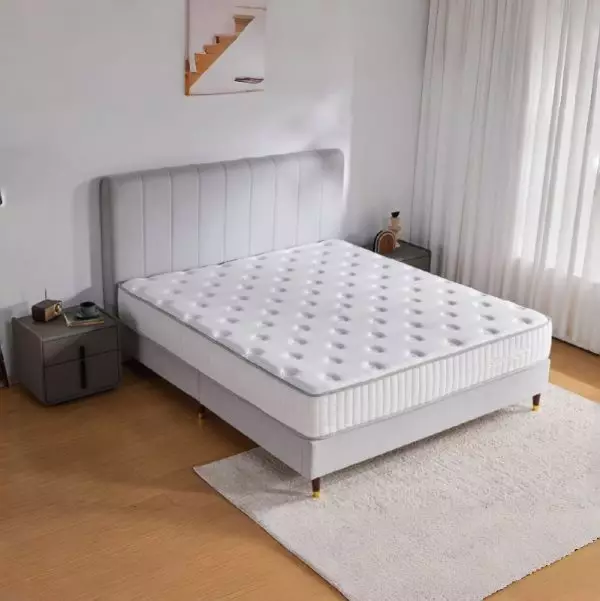
A traditional flat-pack mattress is delivered without the same compression and rolling process. It remains substantially closer to its finished dimensions during storage and transportation, which means it normally requires more physical space throughout the logistics chain.
This can affect warehouse utilization, transportation planning, and delivery operations. A full-size mattress is bulky and can be more difficult to move through narrow entrances, stairways, elevators, or residential spaces. By comparison, a compact boxed mattress can generally be handled more easily by fewer people.
Traditional delivery does have a practical advantage: the mattress does not need to undergo a decompression period after unpacking. A compressed mattress must be removed from its packaging and allowed to recover its intended shape before its final characteristics can be evaluated.
Logistics and Storage Are Major Differences
For businesses, one of the clearest advantages of compression is packaging efficiency. Reducing the physical volume of a mattress can make storage and transportation more manageable. The USITC notes that mattresses may be shipped either compressed or uncompressed, depending on materials and customer specifications, while mattress-in-a-box products require specialized machinery for compression and rolling.
This distinction matters especially in e-commerce, as compact packaging is easier to ship through standard parcel networks than bulky mattresses requiring specialized transport and additional handling.
For businesses comparing rolled-up mattress manufacturers, the packaging capability should therefore be considered alongside mattress construction. The factory needs to understand whether the selected materials and design can tolerate the intended compression and recover appropriately after unpacking.
Does Compression Mean Lower Quality?
A common assumption is that a compressed mattress must be lower quality than one delivered flat. That conclusion is too broad. Mattress quality depends on materials, construction, workmanship, and quality control rather than packaging format alone.
Testing and industry reviews show that the performance of boxed mattresses varies by model.
However, compression does create an additional manufacturing consideration. The mattress must be designed and produced so that it can recover after being released from its compressed packaging. This makes material selection, construction, and packaging procedures particularly important for manufacturers serving the mattress-in-a-box market.
Setup and Customer Experience
The delivery experience also differs. A flat-delivered mattress is generally ready to place on a bed frame, while a compressed mattress requires unpacking, positioning, and time to expand.
Recovery time depends on the mattress design and materials. Some models expand within hours, while others may take several days to reach their intended size and feel.
For online brands, clear instructions on product pages, packaging inserts, and customer-service materials can help customers understand the unpacking and expansion process.
Choosing the Right Manufacturing Partner
Businesses seeking a mattress-in-a-box supplier should evaluate more than whether a factory owns compression equipment. The supplier should understand the relationship between mattress construction, packaging, storage, transportation, and post-unpacking recovery.
At Suisin Furniture, we offers mattresses within our broader furniture manufacturing portfolio and provides compressed mattress products for businesses considering compact delivery formats. Our manufacturing capabilities support customized furniture production, making it relevant for buyers developing products for particular market requirements.
When evaluating rolled-up mattress manufacturers, buyers should ask about available constructions, compression compatibility, packaging dimensions, quality inspection, sample development, and production capacity. It is also useful to confirm whether the factory can maintain the same construction and packaging specifications consistently during bulk production.
Which Format Is Better for Your Business?
There is no universal winner between compressed and traditional flat-pack mattresses. The right choice depends on the sales channel, logistics model, product construction, customer expectations, and target market.
Compressed mattresses can be well suited to e-commerce and direct-to-consumer sales because their smaller packages simplify handling and delivery. Traditional mattresses may be preferable for showroom sales, conventional logistics, or customers who want immediate use.
For buyers working with Suisin Furniture, the decision should start with the intended application and distribution needs, followed by the right materials, construction, packaging, and production specifications.
Ultimately, compression mainly affects packaging and logistics, while traditional delivery keeps the mattress in its full-size form. Evaluating both product requirements and distribution needs can help businesses choose the format that best supports operations and customer satisfaction.